| Happy Memorial Day! Last week, stocks showed signs of life, with the relentless selling pressure finally abating. Let’s take a moment and enjoy it… Okay, but now, let’s prepare. While we hope that last week marked the end of the bearishness and the beginning of a sustained climb in the market, we can’t bank on that. So, what steps can you take to prepare yourself if the market resumes its downward march? Today, we turn to our macro expert Eric Fry for help. As he writes below: …It pays (both literally and figuratively) to hedge against market declines. A few simple strategies can help you cross the line from “sheer panic” to “slightly inconvenienced” – and the latter is indeed the best we can aim for in a bear market such as this. So, grab your burger off the grill and take a few minutes to check out some simple but powerful ways to protect your portfolio. Have a great Memorial Day, Jeff Remsburg | | | | ADVERTISEMENT Eric Fry Names His 25 Stocks to Avoid in 2022… We are approaching a critical time in the stock market… And Wall Street legend Eric Fry says 25 companies will NOT survive. Click here for more. | | | Fight Back Against Market Downturns with A Few Simple Strategies Most investors make little effort to hedge against market risk. In fact, I would say they rarely even think about hedging… except when “brutal” becomes the adjective of choice when describing the markets. 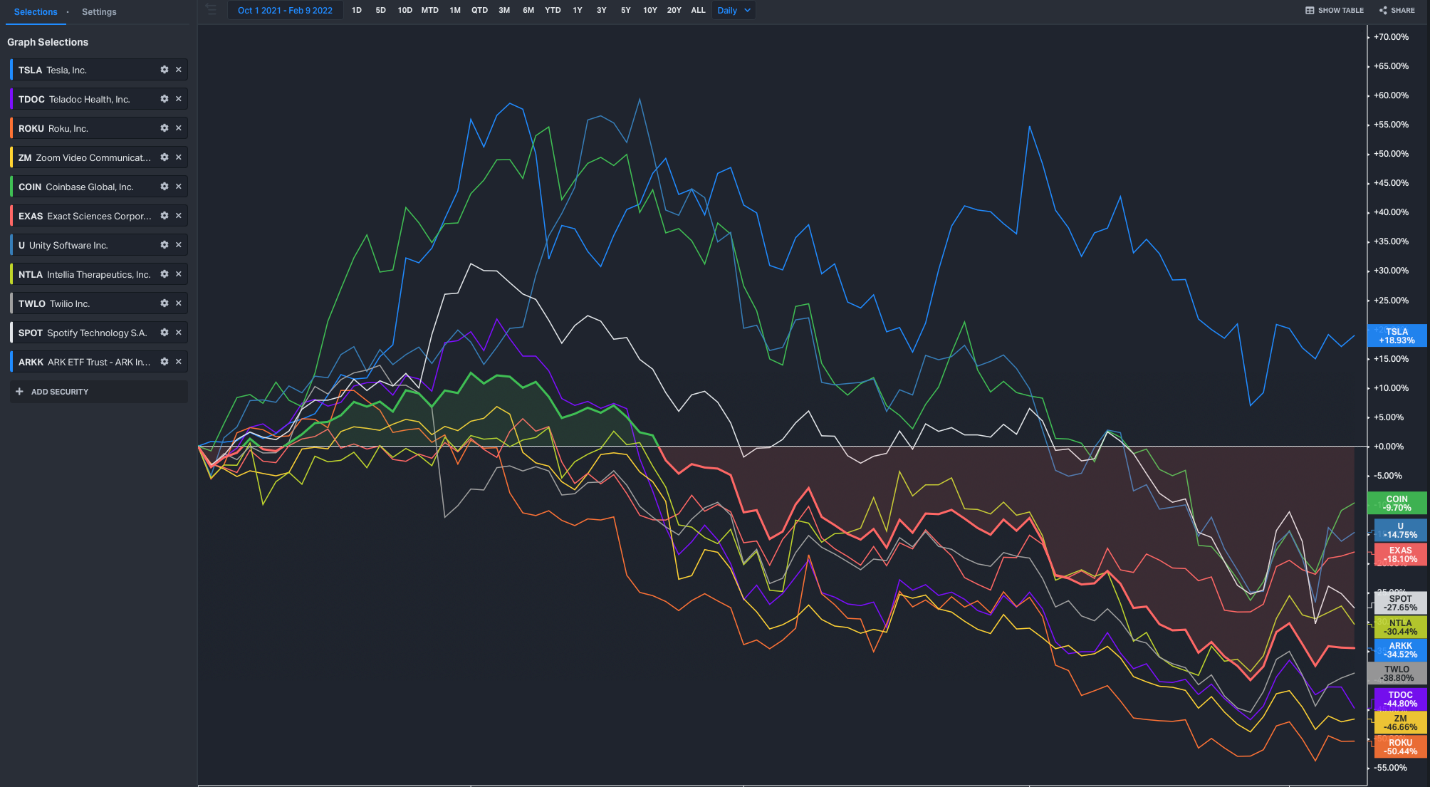
Source: koyfin.com Most of the time, investors simply accept the stock market’s occasional downturns as the “price of admission” for making money during its upturns. And, to be fair, the market rises over time. A long-term investor can usually do okay ignoring the downturns if they invest in good stocks to begin with and remain patient… Then there are painful periods like right now. The losses deepen, and the recovery time for portfolios increases… So much so that the time cost may be even more damaging than the actual dollars lost. That’s why it pays (both literally and figuratively) to hedge against market declines. The best thing about hedging? It doesn’t have to be complicated. A few simple strategies can help you cross the line from “sheer panic” to “slightly inconvenienced” – and the latter is indeed the best we can aim for in a bear market such as this. | ADVERTISEMENT The Retirement Secret to $1,290 Daily Payouts? (Just $7) You’ve heard it all before…Buy and hold stocks. Pay your broker fees. Make 2% a year…That’s the HARD way to get rich. Forget that. There’s a much better way.
This secret shows you how one simple transaction can get you instant cash payouts of as much as $1,290… $1,525… and $1,795 IN A SINGLE DAY. All for just $7 bucks. Read on for the free details… | | | Generating Positive Returns in Any Market Alfred Winslow “A.W.” Jones did not resign himself to “inevitable losses” on the path to profits. Instead, he came up with the idea of a “hedged fund” that could bring balance during the stock market’s rough patches. In 1949, he launched a new fund from an office down the street from the New York Stock Exchange and began pursuing a novel strategy: He bought stocks he believed would rise while selling short stocks he believed would fall. By simultaneously betting on both rising stocks and falling ones, Jones believed he could eliminate (or at least reduce) the “market risk” that afflicts traditional investment strategies. In other words, he thought his strategy could generate positive returns, even during times when the overall stock market was falling. Sounds pretty good right about now, doesn’t it? Jones was an interesting guy. During his formative years, he studied at Harvard University, spied for an anti-Nazi group in Berlin before World War II, rendezvoused with Ernest Hemingway on the front lines of the Spanish Civil War, and wrote for Fortune magazine. Although these activities did not share any obvious connection, each of them contributed to the educational mosaic that produced Jones’s investment perspective. Presumably, experiences like these enabled Jones to understand both the potential rewards of risk-taking… and the associated pitfalls. Essentially, his strategy was born of the understanding that things go wrong sometimes, even if they go right most of the time. As the eminent financial writer James Grant explains: The germ of the case for a hedged portfolio is that long-range predictions about economic growth or interest rates or corporate cash flows are likely to be no more reliable than the seven-day forecast on your weather app… Adherents of the hedged approach have nothing against bull markets – or, as far as that goes, bear markets. They aim to be indifferent to each while producing satisfactory results in both. The “satisfactory results” to which Grant refers are what most professional investors call “absolute return.” It is a return that is not dependent upon, or relative to, market direction. It does not require nourishment from a bull-market trend. Over the decades since Jones launched his new-fangled fund, a wide variety of hedge-fund strategies have emerged. Although many of them still focus on buying and shorting stocks, others utilize some combination of bonds, currencies, futures, private equity investments, derivatives, and what-have-yous. No matter the exact tactics, most hedge funds attempt to construct some type of “market-neutral” portfolio that can generate a positive return – no matter if the stock market is rising or falling. In theory, “market-neutral” strategies are the fat-free ice cream of investing. They deliver at least some of the good stuff while eliminating almost all the bad stuff. | ADVERTISEMENT He Says to Make This Financial Decision In 2022… And with over 40 1,000% winners, he has the track record to back it up. Eric Fry wants you to hear his message now for free. Click here to find out more. | | | Playing Defense and Offense We investors do not need to swing for the fences every time we step the plate. Sometimes, it’s a good idea to shorten our swings and try to hit singles. Heck, it’s even good to hit by a pitch. And when times get really tough, select short sales or other portfolio hedges like inverse ETFs can help a portfolio “score runs” when most typical investment strategies are striking out completely. Because short sales produce profits from falling stock prices, they can provide a valuable “hedge” to your conventional portfolio. To be sure, short sales can be risky, even when they are part of a market-neutral trade. But so can owning stocks during a bear market. I managed a hedge fund, so I understand that some investors have little interest in advanced strategies like options or short sales. That’s okay. Most of us don’t like betting against companies, or the idea that we will lose money if a stock increases in value. If you are one of those who might prefer more basic forms of hedging, you can look at traditional investments like gold stocks and oil stocks, which can sometimes zig when the market zags. You can also consider “inverse funds” that move in the opposite direction of the index to which they are tied. One example: the ProShares Short S&P 500 ETF (SH). If the S&P 500 is down 1.5% on a given day, SH would be up 1.5%. You can find inverse funds on most any index or sector. Here’s another example: With bond yields rising as interest rates increase, bond prices are falling. As such, you can look for a fund that profits from falling bond prices, like the ProShares Short 20+ Year Treasury ETF (TBF). 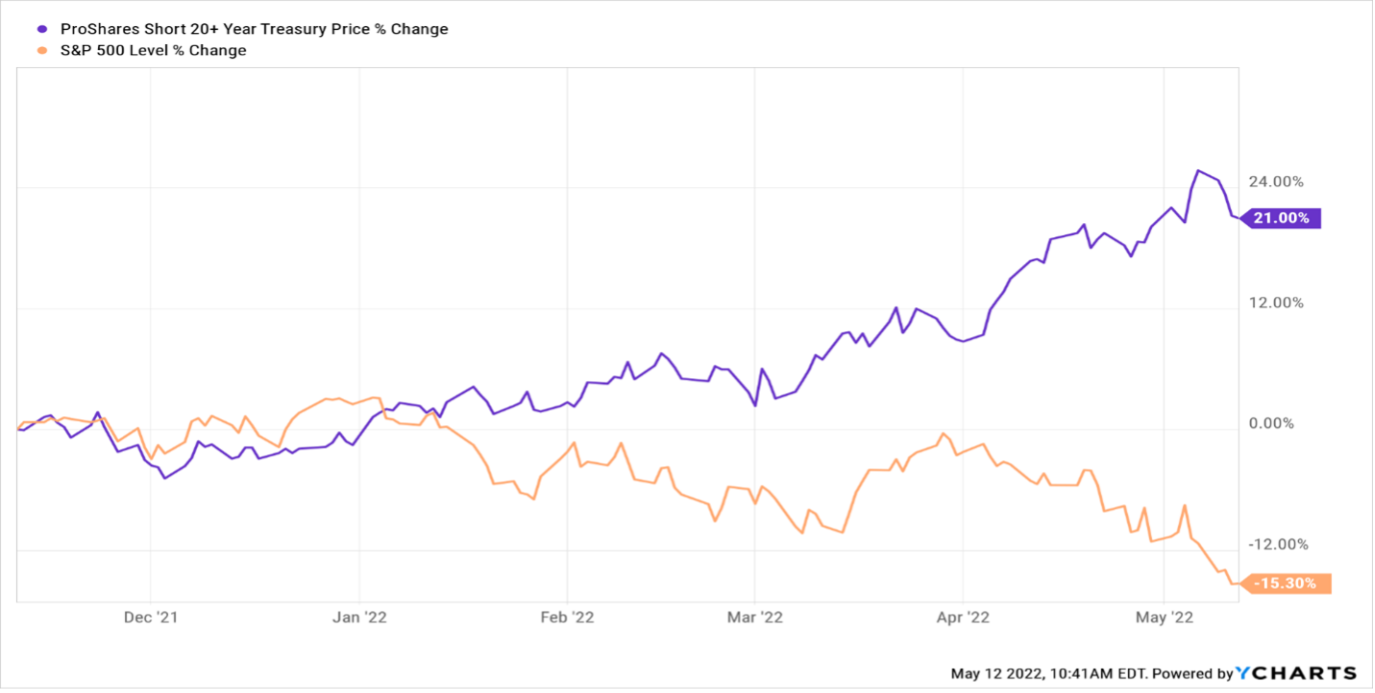
TBF has crushed the market these last six months, up 21% versus a 15% loss in the S&P 500. (In fact, I recommended buying shares of TBF in my Investment Report research service on Jan. 14, 2022, and our position is up 17.50%. You can learn how to get in on this recommendation and more by clicking here.) Although “indirect hedges” like these do not automatically rise when the overall is falling, the current market has demonstrated that they can deliver big gains amid market turmoil. Hang in there. Sincerely, | 




没有评论:
发表评论