
TickerTalk Headlines for June 14th
In this newsletter:

Top 2 Cheap Dividend Growers to Buy Now and Ride Into Retirement
The RV industry has had its share of ups and downs, spurred to record heights by the COVID-10 pandemic and social distancing only to contract by 50% in its wake. Today’s takeaway is that the RV industry is returning to growth and is expected to accelerate over the next six quarters. As murky as the outlook for inflation and interest rates can be, it is generally accepted that the FOMC will start cutting rates this year or early next and reinvigorate the economy. Lower rates equate to lower payments, and lower payments will be a trigger for this and all discretionary markets.
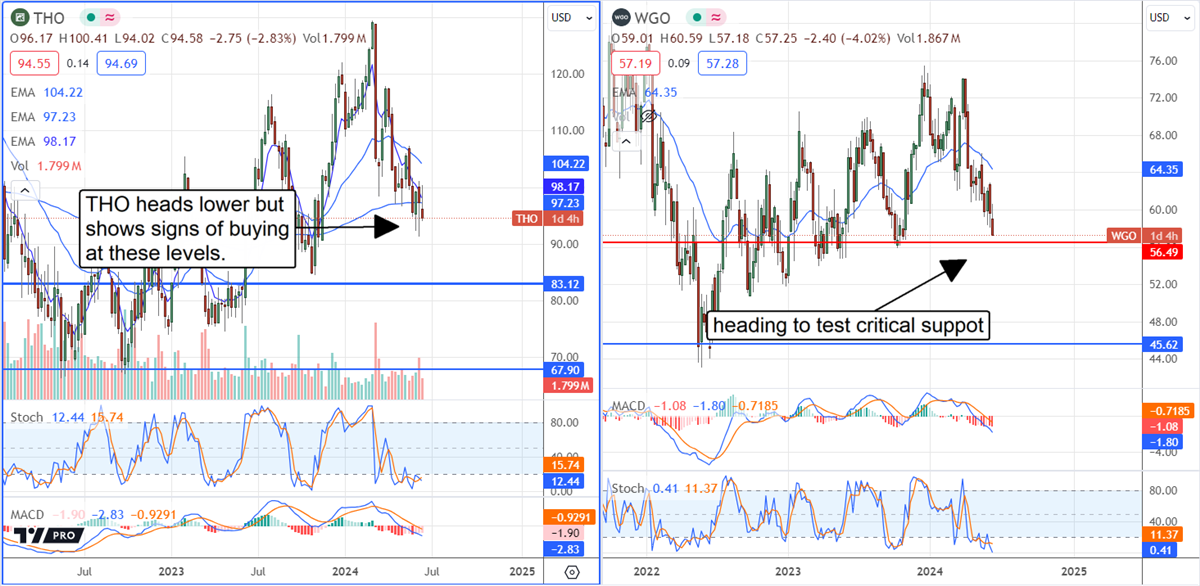
The latest data from the RVIAA is promising. The forecasts for 2024 delivery growth were trimmed but still robust, forecasting a low-to-mid-teens growth pace accelerating to faster levels next year. Today’s opportunity is that industry leaders Thor Industries (NYSE: THO) and Winnebago’s (NYSE: WGO) stock prices have corrected to a one-year low because of the weakened outlook, setting up their markets to rebound in the 2nd half and sustain upward price momentum into 2025.
Among the critical details for investors include their respective low valuations and reliable yields. Neither can be labeled a high yield, but both are above the broad market average, trading near their lows and are reliable. These are dividend-growing companies with payout ratios below 40% and the ability to continue increasing their payouts long into the future. Balance sheet highlights include strong cash positions, low debt, and increasing equity. Both operate with less than 1.25x total leverage and have the cash flow to sustain it while paying dividends and buying back shares. Investors looking for cheap stocks to buy and hold for income could do worse.
Thor Industries Trims Guidance: Reiterates Outlook for Long-Term Growth
Thor Industries had a solid FQ3, outperforming on the top and bottom lines as the business contraction slowed. The issue for the market was the guidance, which was trimmed. Even so, the new range is sufficient to sustain operational quality and capital returns until growth returns. That is expected as soon as the first fiscal quarter of 2025, which coincides with the calendar first quarter of 2024. Operational quality is the key. The company aims to maintain margin and spending discipline rather than chase less profitable growth and risk diluting the brand.
Winnebago will report its Q3 results in early July and likely report similar strengths. The analysts have lowered their targets significantly since last quarter and set the bar low. The consensus reported by MarketBeat.com forecasts a 10% YOY contraction that is more than double the contraction posted by Thor Industries.
The Sell-Side Supports THO and WGO Stocks Prices
The analysts trimmed targets for Thor Industries after the Q3 release and will likely do the same for Winnebago, but their support is unwavering. The stocks are rated at Moderate Buy and viewed (in the case of THO) as fairly valued near the current levels. This sentiment may weigh the action and cap gains this summer, but a bearish reversal or downtrend is unlikely. Winnebago is trading well below the low end of the analyst range, suggesting it is a value even with sluggish 2024 sales and price target reductions.
The price action in these stocks is choppy but has been trending higher for two years. The volatility is driven by the interest rate outlook as much as anything else, resulting in numerous buying opportunities. Among the buyers are the institutions that hold nearly 100% of both companies. Their activity has been mixed over the last few quarters, but no red flags have been present.
Assuming the institutions don’t start shedding them, these stocks should bottom soon and begin the next rebound. The risk is the Fed. The longer the Fed waits to make the first interest rate cut, the longer the rebound will take to gain traction, and the greater the risk these stocks will move lower.
AI's Next Magnificent Seven (Ad)

The Original Magnificent Seven Produced 16,894% Average Returns Over 20 Years.
See His Breakdown of the Seven Stocks You Should Own Here. >
3 High-Yield Dividend Stocks for Income Now and Growth Later
The latest readings on inflation show some cooling, and stocks seem to like it. However, it's important to be clear about why investors feel bullish. Inflation growth of around 3.3% won't prompt the Federal Reserve to lower interest rates, but it won't cause them to hike rates either.
So, if the next directional move for interest rates is lower, this is a good time to buy stocks. That's particularly true of stocks that are trading at a discount. Sadly, investor psychology can make it difficult for some investors to buy quality stocks when they're on sale.
But that's the key to long-term investing. And it's particularly true for stocks that pay a high-yielding dividend. Buying shares at a low price today gives you current income that you can use to manage inflation or reinvest for more shares. Then, when rates go down, the prices of these stocks will move higher to give you growth along with that dividend income.
Higher Oil Prices: Chevron's Inevitable Gain
Energy stocks, particularly oil stocks, were supposed to benefit from lower interest rates this year, which would boost demand. That hasn't been the case, and that's reflected in the price of Chevron Corp. (NYSE: CVX) stock, which is up just 3.4% in 2024 and is still down about 2.9% in the last 12 months.
However, at the risk of sounding like a broken clock, the long-term oil price will be higher. OPEC+ is maintaining output cuts while the Biden administration continues to release oil from our country's strategic oil reserve to keep prices down. That's a supply-demand imbalance that will have to be worked out in favor of higher oil prices.
And when interest rates move lower in late 2024 or early 2025, oil demand will increase. In that situation, CVX stock displays the qualities of a stock you'll want to own.
The company's merger with Hess Corp. (NYSE: HES) will likely be completed this year and give it much more leverage over oil prices. And today, investors get an attractive dividend with a 4.2% yield. Plus, the Chevron analyst forecasts on MarketBeat suggest growth of over 20% for CVX stock in the next 12 months.
Bristol-Myers is a Poor Trade But a Good Investment
The Bristol-Myers Squibb Co. (NYSE: BMY) is being weighed down by significant debt and concerns over patent expirations on some of its best-selling drugs. Both of those have soured traders on the stock, which is down 34% in the last 12 months and 17% in 2024.
Revenue is growing, albeit at a modest pace. However, the company posted a concerning $4.40 loss per share in its first quarter of 2024. That's a reminder that the company is digesting acquisitions it made to expand its pipeline. Unfortunately, that dilution is expected to weigh on earnings for the rest of 2024.
So, it's possible, perhaps likely, that BMY stock still has further to fall. However, with short interest only about 1.4% of the stock's float, selling the stock short is not a guarantee.
The strategic choice is to take a long position. You'll capture a dividend that yields 5.79% and pays out $2.40 per share annually. And when interest rates become more favorable, BMY stock will be positioned for a strong recovery.
The Worst Could be Over For UPS
At a time when e-commerce continues to grow, a company like United Parcel Service Inc. (NYSE: UPS) is a bellwether for the economy. So, when the company missed the top line in its first quarter 2024 earnings report, the market took notice. It doesn't matter that the company is facing rough comps to 2023 and 2022 - lower revenue is lower revenue.
UPS is implementing efforts to streamline costs and raise productivity, but those will take time to show up on the bottom line. In the meantime, the primary issue bedeviling investors is rising labor costs at a time when demand is lower. The consumer has held up stronger than economists expected. However, there are clear signs that consumer spending is slowing, at least on goods.
Another area of concern is debt. UPS has a higher debt load than it did 10 years ago, and servicing that debt is more expensive now, albeit not at historical levels.
For all that, this company still has strong financials that are being hit by cyclical headwinds. Investors can still collect a dividend with a current yield of 4.85%. And the UPS analyst forecasts on MarketBeat give UPS stock a 22.7% upside from its current level.
"The Biggest Drug Ever" Is Coming (Ad)

UBS bank predicts it will become "The Biggest Drug Ever."
The Wall Street Journal believes it will be "Pharma's biggest blockbuster yet."
Bank of America predicts it will be the world's first "$100 billion dollar a year drug."
And Morgan Stanley predicts 250 million prescriptions will be written each year.
What is a Bull Flag Pattern? Explanation and Examples
When you enter a bull flag pattern, you are never chasing the top. Instead, you're waiting patiently for the pullback to complete and enter the breakout trigger. In this article, we'll dissect the pieces of a bull flag so you can identify them and review how to trade them.
Characteristics of a Bull Flag Pattern
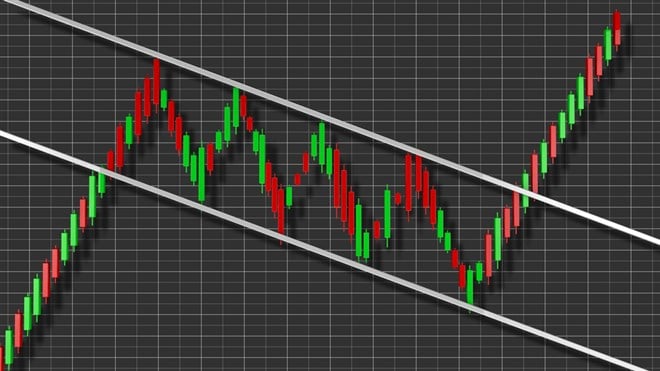
A bull flag pattern can be seen as two rallies in a stock separated by a pullback in between. It indicates an initial buying frenzy that spikes the price of the stock, which then takes a rest as it sells off before surging again as buyers rush back into the stock.
Formation of the Bull Flag
A bull flag is a stock chart pattern comprised of three parts: the flagpole, the flag, and the breakout. The flagpole, sometimes called an impulse wave, is a parabolic stock price rise and signals the start of a bullish trend. After the spike peaks, it forms a consolidation phase known as the flag. This pullback consists of a series of lower highs and lower lows in a parallel manner, representing the upper and lower descending trendlines. The pattern culminates in a breakout where the price exits the flag pattern and surges through the upper trendline resistance.
Technical Indicators
Bull flag patterns are best identified on a candlestick chart. You can also use various technical indicators to identify, visualize, and confirm them. Some popular analysis tools include price indicators like moving averages and Bollinger Bands and momentum indicators like the relative strength index (RSI), moving average convergence divergence (MACD) and stochastic oscillators.
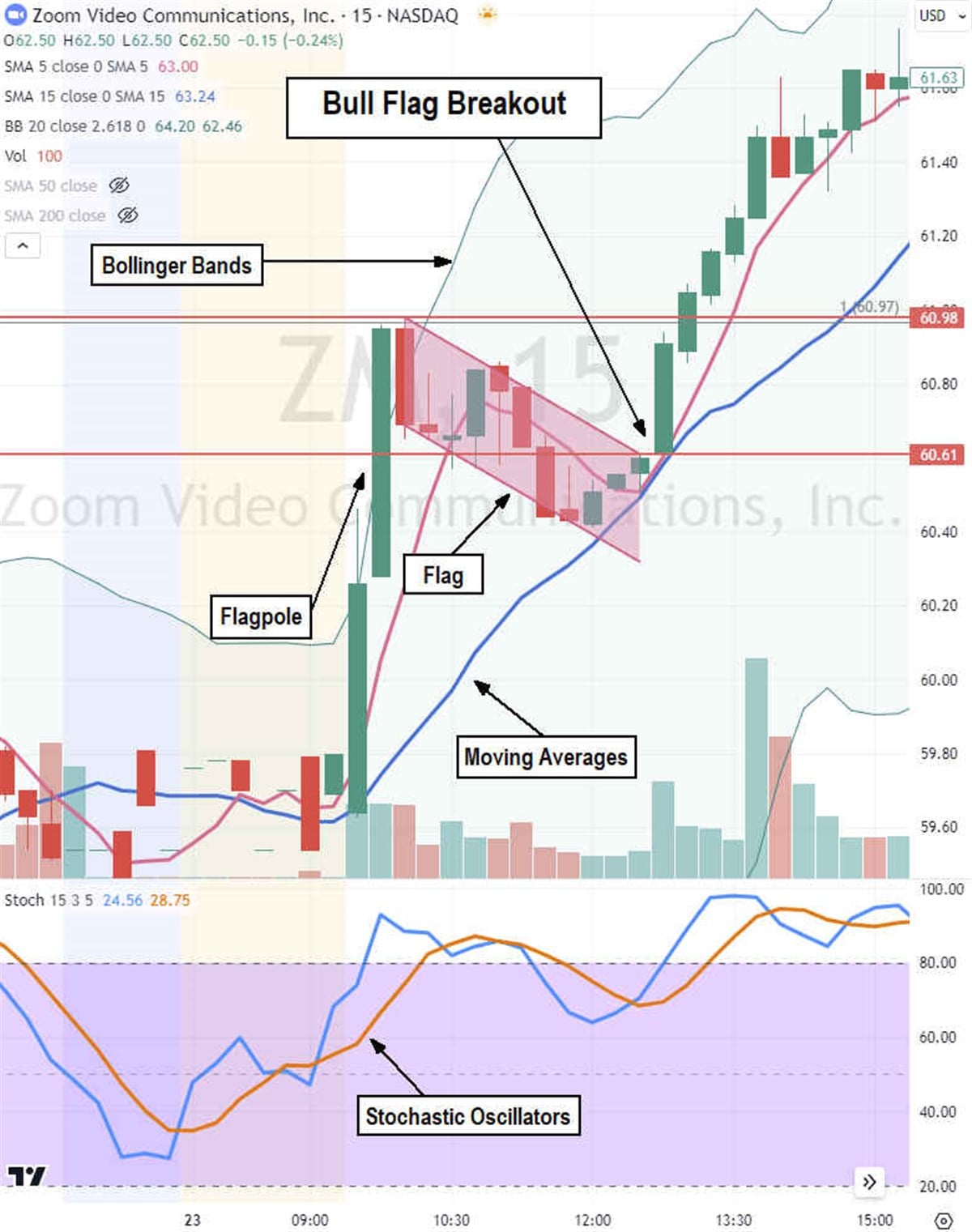
Remember that bull flag patterns are linear through all time frames. This means they can form on any time frame chart from a one-minute, five-minute, 15-minute, or 60-minute to daily, weekly, or monthly charts. Robust stock patterns, as a rule, should be linear in all time frames.
Tips for Trading the Bull Flag Pattern
Bull flag patterns provide opportunities to buy a long position in the underlying stock. As with all trades, it's prudent to plan your entry and exits, which include profit and stop-loss exits. You can also include a momentum indicator to confirm the breakout and momentum shift from selling to buying. The RSI is a great tool to confirm a breakout when it rises again.
Entry Points
To determine the entry points on a bull flag pattern, it’s important to make sure you have the proper parallel lines representing the upper descending and lower descending trendlines. The upper trendline is formed by connecting the candlestick highs starting from the peak of the flagpole. The lower trendlines are formed by connecting the lows of the candlesticks. The lines should be parallel. Many charting platforms have a drawing tool called “parallel channel” to plot these.
The entry point for a bull flag pattern is when the stock breaks out through the upper descending trendline. Therefore, the entry points are above the upper descending trendline as the price exits the flag formation. Try to enter as close to the breakout level as possible to increase the potential for gains.
Setting Stop-Loss and Take-Profit Levels
Once properly set up, the stop-loss level can be on a new lower low or under the lower trendline price of the flag. Taking a stop on the next lower low can cut losses much earlier than taking a stop under the lower descending trendline.
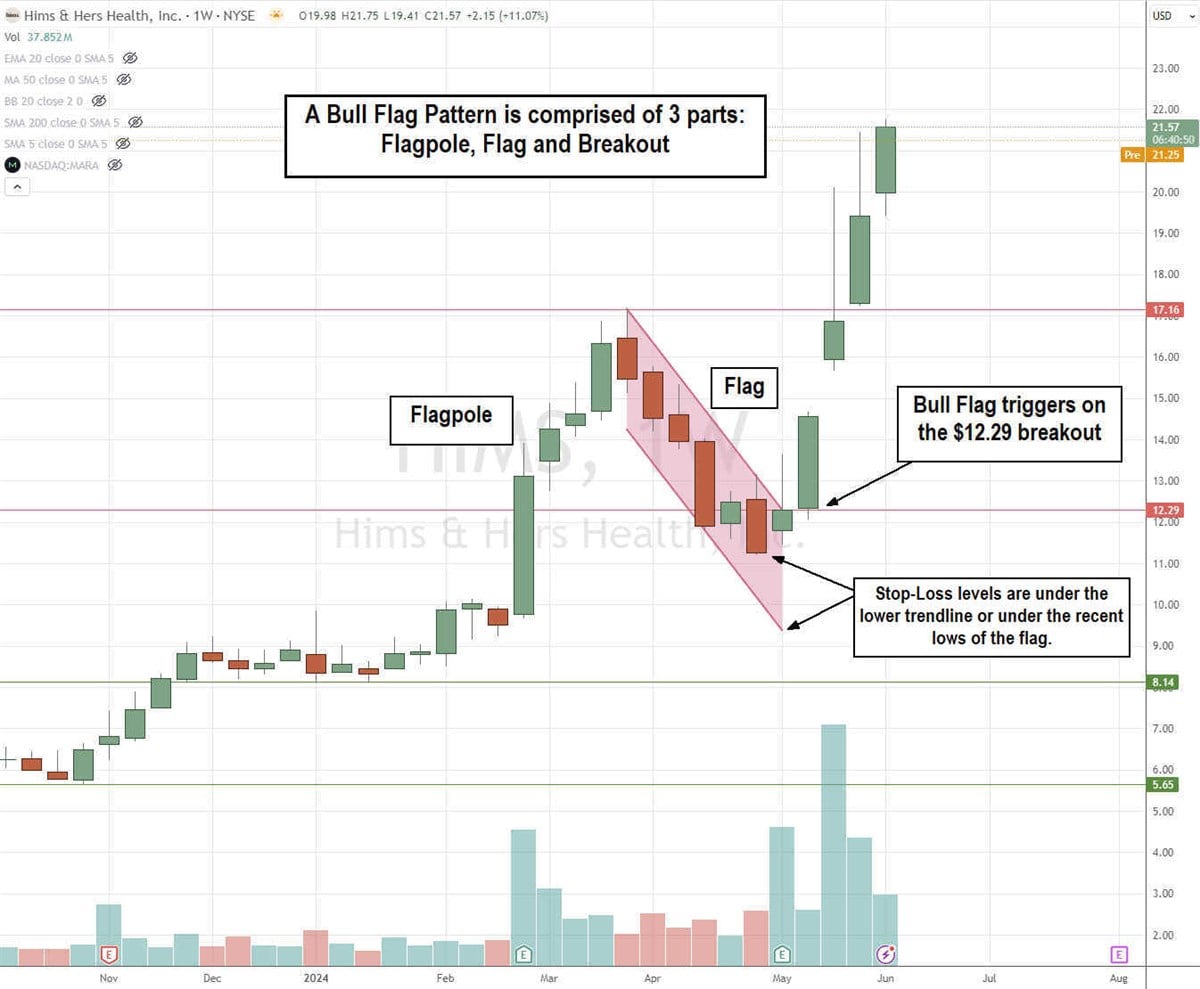
Profit taking levels can begin when the stock rises to the peak of the flagpole level or the high of the flagpole. After that, you can take profits incrementally utilizing various methods, including a momentum peak using the RSI or stochastic indicator or sell into the strength on a gap fill.
Advantages of Trading Bull Flag Patterns
Trading bull flag patterns offers several key advantages that make them a popular choice among traders. They have very distinct setups that can be rather easy to identify once you get used to spotting them. They have very distinct entry and exit levels. Most importantly, they are linear across all time frames, so they can occur frequently across stocks that trade in similar industries and sectors. When a benchmark index forms a bull flag pattern, it can trigger across many stocks simultaneously. As the saying goes, "When it rains, it pours."
Predictability and Reliability
The predictability and reliability of bull flag patterns are subjective, so when it comes to bull flags, the most important thing to do is react, not predict. Bull flag patterns are known to be particularly effective in bull and rising markets, offering reliable continuation signals. When they break out through the peak of the flagpole, it means the next leg of the uptrend.
Risk-Reward Ratio
The risk-reward ratio can vary depending on the specific trade. Ideally, you should aim for a 1:2 risk-to-reward ratio when trading a bull flag breakout, i.e. a $1 gain for every 50 cents risked on a stop-loss. This helps in identifying quality setups. However, in some cases, a 1:1 ratio may be acceptable if the probability of making the profit is 90% or higher. This assessment can be enhanced using multiple indicators and time frames for a Doppler radar effect.
Common Mistakes to Avoid
You can improve your bull flag trading strategy by understanding and avoiding these common mistakes:
Misidentifying the Pattern
Bull flags can be misidentified, especially if they are missing any of the three necessary parts of the formation, including the flagpole (parabolic price surge), the flag (parallel descending trendlines) and the breakout (price surges through the upper descending trendline). If the flagpole peaks but forms a drop and higher lows against a flat-top high, this is an ascending triangle pattern. If the flagpole peaks and then forms lower highs and higher lows, this may be a pennant pattern. While these are bullish patterns, they aren't bull flags.
Ignoring Market Context
Ask yourself, would it be easier to light a campfire during a rainstorm or a sunny day? Context makes a huge difference. The same applies to the stock market. Bull flag patterns work best in bull markets, so be sure to take advantage of rising markets and train yourself to spot bull flags, but also be frugal in falling markets.
Example of a Bull Flag Pattern
Let's take a look at a bull flag breakout in medical sector stock Teva Pharmaceutical Industries Ltd. (NYSE: TEVA), a leading manufacturer of generic and biosimilar medicine.
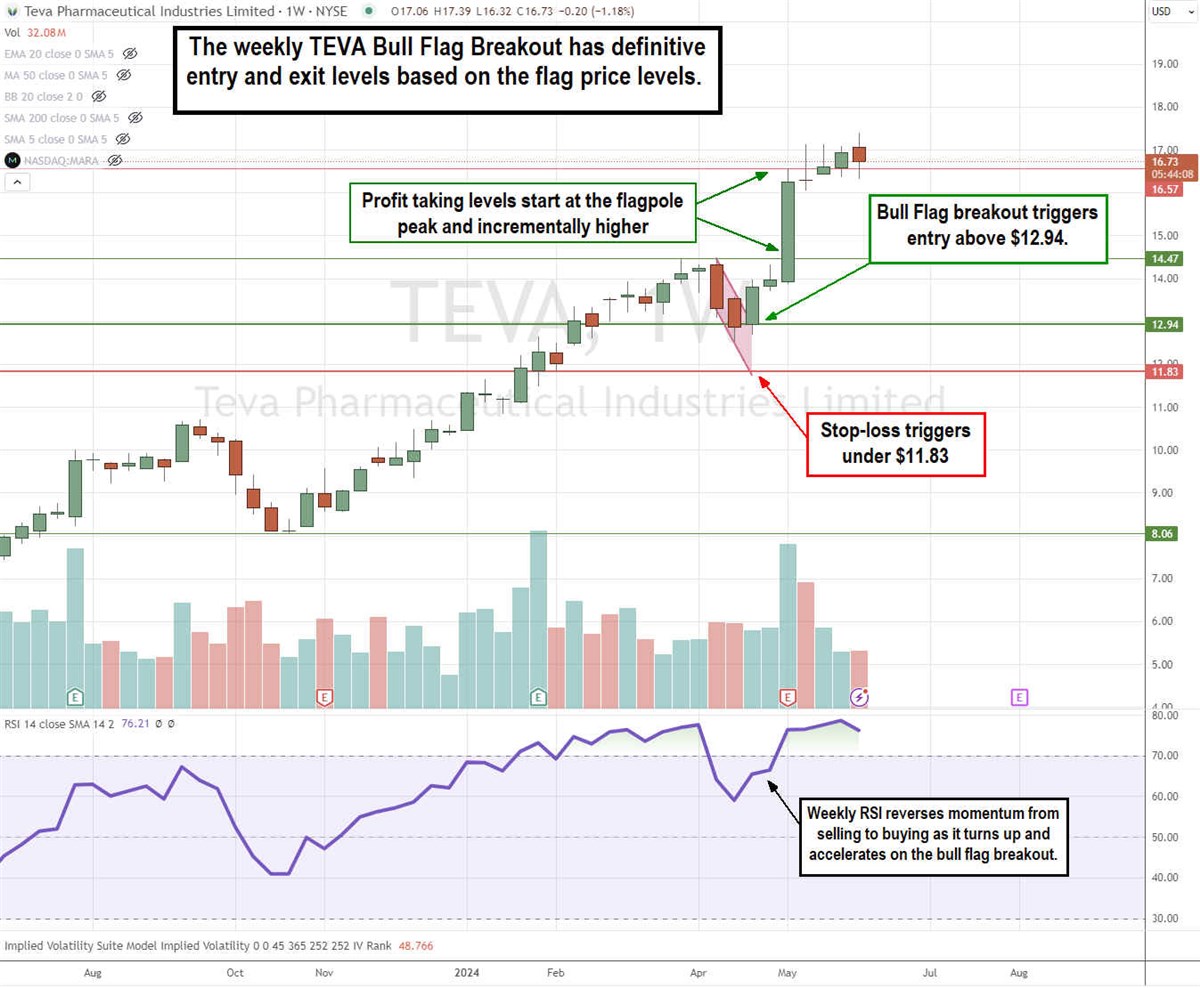
The weekly candlestick chart on TEVA illustrates a bull flag breakout. The flagpole forms from a swing low of $8.06 on October 23, 2023, rising to a peak at $14.47 on April 8, 2024. The flag forms from the $14.47 peak as it falls in parallel lower highs and lower lows, reaching a low of $12.51. The RSI fell from the overbought 78-band down to the 60-band, where it bounced with the stock. TEVA formed a breakout through the flag’s upper trendline at $12.94 on April 22, 2024. This triggered the entry long. The stop-loss at the break of the lower trendline would be under $11.83. The weekly RSI bounced back up through the 70-band as TEVA bounced back up through the $14.47 flagpole high. TEVA surged to $16.64 on its earnings release and continued to grind higher to a peak of $17.39 as the next leg continued the uptrend.
Plan Your Trade and Trade Your Plan
Whether you’re a trader or an investor, having a plan is always prudent before clicking the buy button. Bull flags present opportunities to enter or reenter an uptrending stock. However, it would be best to lay out the fundamental and technical reasons for entering the trade ahead of time. Don't predict the breakout; wait for it to occur and then react with your entry. Once you have entered your position, it's important to have the discipline to take profits and stop losses as they occur. Don't let a small loss turn into a larger one; stops are a pause in your trading, not the end. As a rule of thumb, it's wise to raise your stop loss levels as the stock rises. And remember: not all bull flags result in continuation; sometimes, the breakout loses momentum. Be prepared to exit the trade if it doesn't play out as expected.
Level Up Your Stock Analysis with MarketBeat
Traders use bull flags to identify potential entry points into the next leg of an uptrend by waiting for a pullback and then entering at the breakout trigger. MarketBeat's libraries of resources and tools can help you identify the pattern, plan entries and exits, and manage risks when trading bull flags.
AI "wealth window" will close June 25 (Ad)

Today, I'm making my boldest prediction ever.
Next-generation AI technology will create the first $100 TRILLION industry.

TickerTalk is your daily email briefing covering top stories influencing the stock market. Stay informed, stay ahead.
MarketBeat Media, LLC dba TickerTalk
345 N Reid Place, Suite 620, Sioux Falls, SD 57103.
contact@tickertalk.com

没有评论:
发表评论