Eye-popping AI salaries … enormous AI growth is coming … where we are in the adoption curve … where the next “profit wave” will crash … an AI event with Eric Fry tomorrow night Recently, a “machine-learning” product manager position at Netflix came with a total compensation value (salary and benefits) of…
$900,000.
It’s not the only company shelling out huge bucks for AI talent.
Here’s The Wall Street Journal from last year: American companies are in the midst of an AI recruiting frenzy, and some are willing to pay salaries approaching seven figures to hire top talent…
Compensation is a battleground. Aware that in-demand AI specialists can command several job offers, many companies are dangling salaries in the mid-six figures along with bonuses and stock grants to attract experienced workers, recruiters say. The article went on to list a few other listed AI positions with enormous salaries…
Online-dating platform Hinge was offering a base salary of $332,000 to $398,000 a year… vice president of AI and machine-learning position at Upwork, listed at $260,000 to $437,000 a year… and a senior manager of applied science and generative AI at Amazon with a top salary of $340,300.
Keep in mind, the largest operating expense for most businesses is labor cost (up to 70% of total business costs). So, you can be sure that if companies are offering these eye-watering salaries, they’re expecting an enormous return on investment from AI-related positions.
And, in fact, PriceWaterhouseCoopers recently put a number on the forecasted economic impact of AI…
$16 trillion by the year 2030.
Of course, this number is so enormous that we have trouble processing what it means. So, for context, let’s think of it in “GDP” terms.
If we take every country in the world, rank-ordered by the size of its GDP, a $16 trillion GDP would come in third, only behind the U.S. and China.
In fact, it’s only slightly behind China’s $18.5 trillion GDP. And it’s 3.5X the size of Germany’s GDP (third behind China). 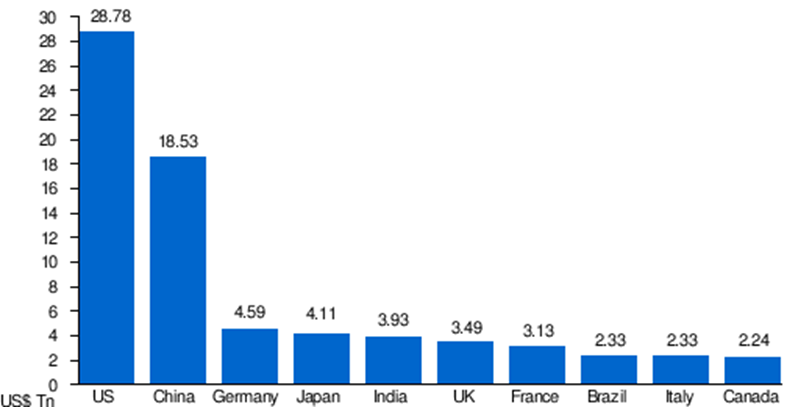 Source: IMF / Wikipedia
I find this humbling.
My efforts to time the market in hopes of sidestepping a potential 20%, 30%, or 40% crash seem silly when viewed in light of the potential for quadruple-digit returns from leading AI stocks in the years to come. ADVERTISEMENT  Elon Musk has already invested $100 million of his own money in this hot new AI trend.
Google, $600 million. Jeff Bezos’ Amazon has invested $4 billion.
And Bill Gates’ Microsoft has invested $13 billion.
Former hedge fund manager Eric Fry found a company that he believes will lead this revolution.
Click here to see the details and he’ll show you how…
It could hand you up to 40 years of Nvidia gains in a matter of months.
(By clicking the link, your email address will automatically be added to the Event RSVP list.) As we see the first few swells of this $16 trillion AI tsunami lapping the global economy, the question investors are asking is “what’s the best way to invest in it now?” As we answer that, let’s begin with those “first few swells” just referenced – which puts the Magnificent Seven stocks squarely in our crosshairs.
Let’s go to our macro expert Eric Fry for some details: In the early phase of the AI boom in 2023, seven clear winners emerged. You know their names. CNBC’s Jim Cramer dubbed them the “Magnificent Seven.”
And their performances certainly were magnificent. They gained an average 111% in 2023.
Of course, the biggest winner of 2023’s boom was Nvidia Corp. (NVDA), the AI chip king, which surged 239% in 2023. Since the unveiling of ChatGPT, shares of the company have skyrocketed nearly 450%.
In different ways, each of these companies has been providing the hardware, software, and processing power that enable enterprises to create and operate AI platforms.
They enabled the AI Revolution. Let’s pause here at the word “enable” and use it to help us triangulate where we are within AI’s broader evolution. The roadmap of AI’s growth curve Last summer, we profiled research from our hypergrowth expert Luke Lango that mapped out how to invest in AI at various points in its evolution.
He explained how every new technological paradigm shift follows a similar pattern. We see three distinct “profit waves” …
The first comes from the “picks and shovels” suppliers of the new tech – the companies that make the stuff that powers the technology.
The second profit wave emerges in the infrastructure makers for the new tech – many of the Magnificent Seven stocks have provided infrastructure and hardware that brings AI to market (they’ve also provided the picks and shovels).
And the third profit wave emerges as the software and services developers for the new tech – the companies that create cool, usable applications on top of the new devices.
The soaring Magnificent Seven stocks have mostly represented the first two profit waves (there’s not always a clean division).
Unfortunately, the sudden dawn of the entire AI boom caught most investors by surprise, Eric notes. Therefore, a lot of folks missed out on those big gains.
But today, we’re standing on the cusp of the third profit wave. While Luke’s broad categorical name for these stocks is “the software and services developers for the new tech,” Eric calls them something else…
The AI appliers. ADVERTISEMENT  Do you want a “boring” and reliable way to generate cash... but you also don’t want to wait months, years, or decades for an investment to pay off?
Do you have a smaller amount of capital that you need to start growing ASAP, but you also don’t want to invest in any risky or volatile stocks?
If you answered “YES” to any of this, Then Follow This Link Now To See How You Can Generate Up-Front Cash Payouts Every Trading Day With A 98% Success Rate. If you missed the first two profit waves, you’re right on time for the third one From Eric: Unlike the AI enablers, these companies are not at the forefront of producing the material needed to create AI. Instead, they are employing AI technology within their own products and services.
AI appliers are everywhere… and growing by the day.
That universe includes companies as diverse as beauty-products purveyor Coty Inc. (COTY), gold and copper explorer, Ivanhoe Electric Inc. (IE), industrial-solutions provider Rockwell Automation Inc. (ROK), and sports technology company Genius Sports Ltd (GENI).
Clearly, many of these companies operate in niches that are normally not associated with technology. So, they are still lying low… under the radar – but they and many others are ready to explode with the next phase of the AI boom. Here’s more color from Fast Company’s recent article titled “The most innovative applied AI companies of 2024”: The convergence of advanced algorithms, massive datasets, and computing power has meant AI is already enabling breakthroughs in everything from medicine and biotech to law and entertainment.
In healthcare, for example, companies like Viz.ai can analyze medical data with unprecedented speed and accuracy, aiding in early disease detection and predicting patient outcomes.
Or look to the business world, where AI tools like those offered by Salesforce and Interplay Learning offer valuable insights to help optimize supply chains, improve operational efficiency, and enhance customer service.
And for those seeking the more sci-fi-esque use cases, look no further than Google DeepMind, whose researchers use AI to better classify genetic mutations that can affect the function of proteins in our cells. We are at the very beginning of what happens when AI begins to alter our world in everyday, practical ways, enabling real societal change. ADVERTISEMENT  Right now, Luke Lango is tracking a potential $100 trillion opportunity that could send a small group of tech companies soaring 1,000%, 5,000%, even 7,000% or more over the next 12 months. The problem? Luke believes 99% of investors will refuse to participate in this rally.
Find out why here. Tomorrow night at 7 PM Eastern, Eric will be diving into the sector he believes presents investors the most AI enablers As part of this, Eric is confident he’s found the company that will become the next $1 trillion AI stock.
For some perspective, here’s the current list of companies valued at more than $1 trillion. It’s a very small, elite group. 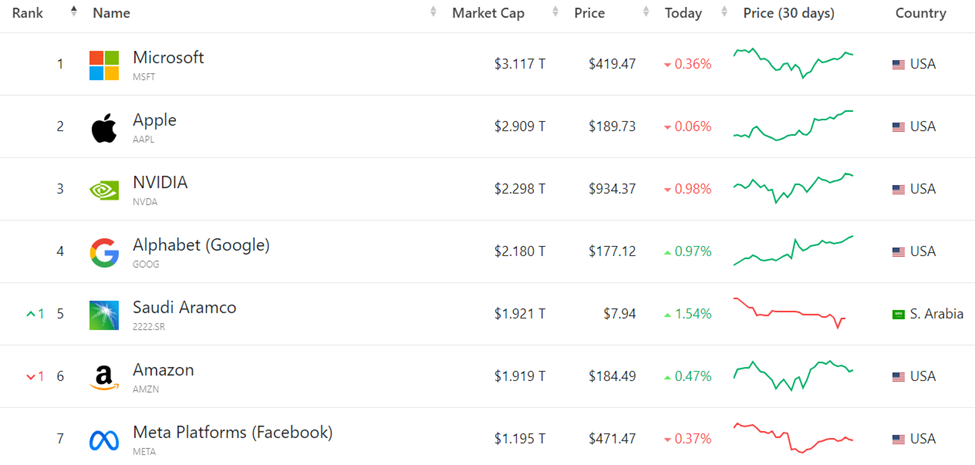 In the Digest two weeks ago, we profiled the power of catching a smaller company before it turns into a mega-cap $1T+ monster with Nvidia as our example.
In May of 2014 – 10 years ago – Nvidia’s market cap was $10.6 billion. That’s not small, but it’s certainly much smaller than today’s market cap of $2.3 trillion.
And what has this market-cap growth meant for Nvidia’s shareholders?
Over this same 10-year period, Nvidia’s stock has exploded 21,844%. 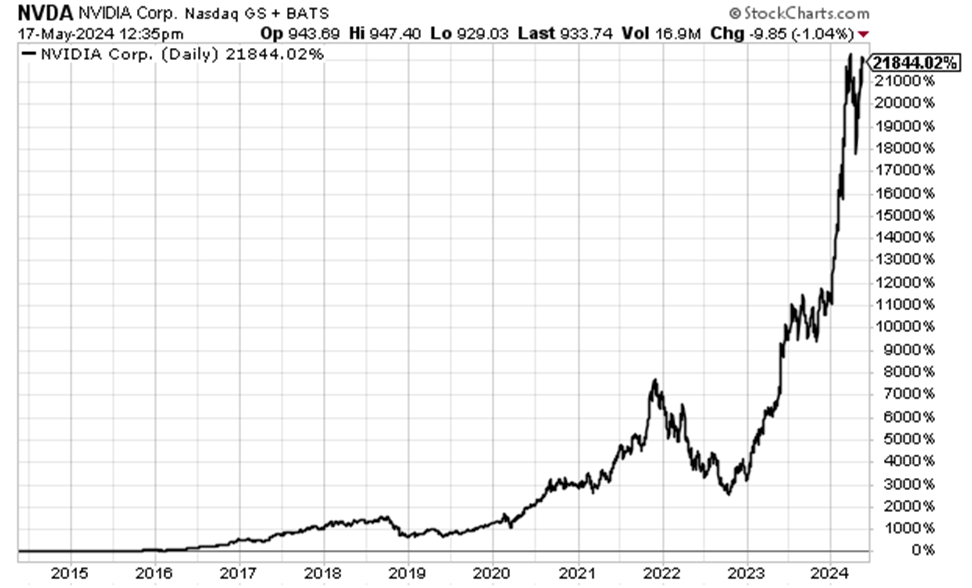 This turns a $10,000 seed investment into $2,184,400.
With that perspective, here’s Eric offering more details about tomorrow: We’re also going to talk about a strategy we can use to get 40 years of Nvidia gains out of this stock in a matter of months.
This company is about to revolutionize a $13.1 trillion industry… with a potential to serve over 3.8 billion people.
Plus, I’m going to have a free pick for you during the event. It’s an AI stock that operates in this promising niche. I believe it could double your money in the coming months.
Click here to immediately sign up for this special event. I look forward to seeing you there. So, recruiters not knocking down your door, waving a $900,000 AI salary in your face?
Join Eric tomorrow for what could be your next best thing from AI. Click here to automatically register. Have a good evening, Jeff Remsburg | | |




没有评论:
发表评论